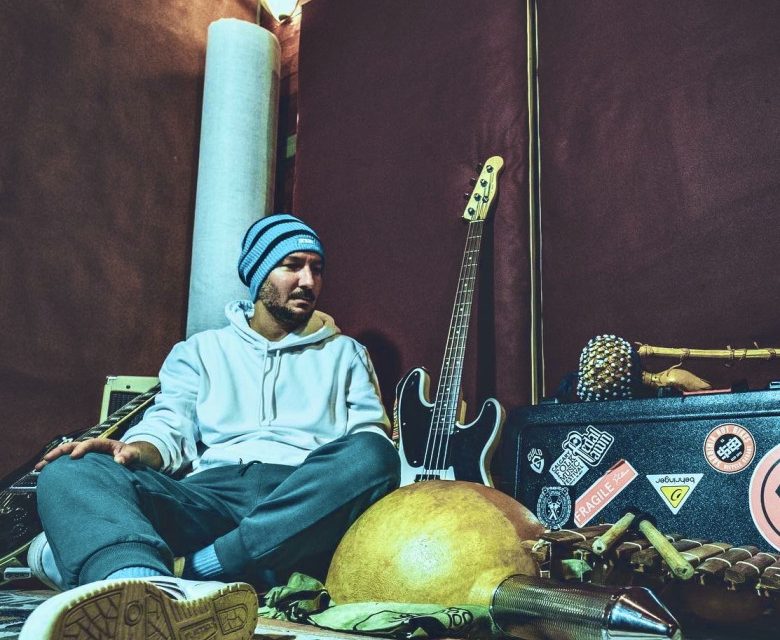
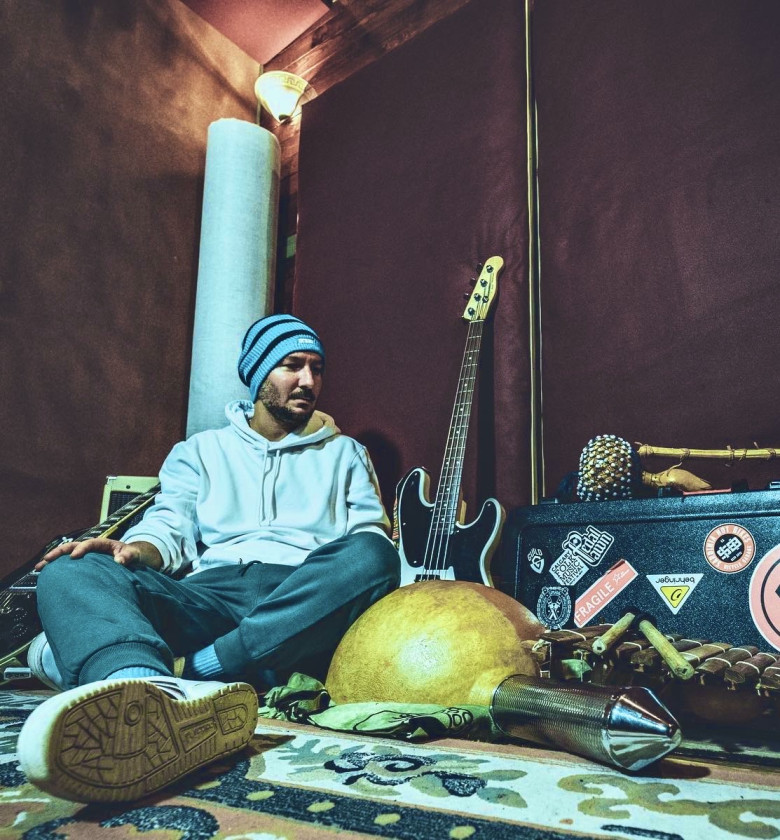
The Continuum: Evolution of an Artist
(A Conversation with Farees)
“The revolution continues on the dance floor for neo-funk producer and multi-instrumentalist Farees.” — KCRW
“Farees is a Mega Talent and a disciple of Jimi Hendrix. He has combined that spirit and soul with his own style. For sure, Farees may help usher in a new era of music. The road he has taken could very well lead him to sit alongside the Music Masters.”
BILLY COX — The Jimi Hendrix Experience, The Band of Gypsys
“This is the most amazing movement to happen with this great music! The welcome return home to Africa! Farees is amazing! The new record is nothing short of outstanding!!”
TAJ MAHAL
“Farees reminds me of the greats. He’s got that Stevie Wonder, Jimi Hendrix vibe, yet he’s doing his very own thing. Ain’t nobody around playing and grooving like him. He’s unique and he’s a superstar!”
LEO NOCENTELLI — The Meters
“Brother Farees carries ancient spirits direct from the Black pool of genius. His guitar playing is always masterful and his singing will transport you. Farees has taken the old wisdom and has come up with new music that puts you in a trance while it bids you to dance.”
COREY HARRIS — Ali Farka Touré, Billy Bragg & Wilco
“Mississippi to Sahara is a great record. I love it, and I love how it sounds. I can only imagine the wonderful songs to come from Farees in the future.”
BEN HARPER
Origins
Before the world knew your name, what first called you toward sound, words, or creation?
Life itself. Rhythm is everywhere—your mother’s heartbeat before you’re born, the music you hear from the womb, the pulse of rain, footsteps, waves. Even silence has rhythm in its pauses.
Before I could form sentences, I was tapping beats on anything that made a sound. At four, I was writing songs about what I saw that day—neighbors arguing, birds singing, a car passing by. Creation came naturally; it wasn’t a hobby, it was breathing.
Music, to me, is the first language ever spoken. Older than words. Older than humans. Nature had its own rhythms and melodies and still does.
⸻
The Awakening
Was there a moment when you realized music wasn’t just expression, but destiny?
There wasn’t one lightning-bolt moment. It was more like a lifelong calling getting louder.
I’d follow sounds through the streets—drummers, radio static, kids humming under their breath. My family didn’t always get it, but I had no choice; I was already hearing songs inside me.
Then at fourteen, I discovered Jimi Hendrix. That changed everything. His music wasn’t just skill; it was spirit. Jimi taught me that repetition is death and that art has to be alive—reborn every time you touch an instrument.
That’s when I knew: music wasn’t something I did—it was what I am.
⸻
Early Sparks
Who were the mentors, records, or street lessons that first shaped your ear?
My ear’s like a traveler that never found one home. I learned from griot chants, gospel choirs, street rappers, desert tribes, Delta blues, and Coltrane solos.
I learned from silence too—the kind that’s so deep you can hear your soul tuning itself.
I absorbed sounds the way sand absorbs footprints—quickly, but with memory. My influences come from everywhere: Africa, the Americas, Europe, Asia. If something has rhythm, I’ll learn from it.
I never divided art into genres or borders. Blues, funk, jazz, classical, rock, hip-hop—they’re all one big family conversation. And I’ve always tried to add my own dialect to that conversation.
⸻
The Engineered Years
Your early rise came with outside pressures—labels, producers, branding. When did you realize a huge part of your image was being constructed for you?
That came slowly. At first, I thought that was just how the industry worked. You make art, they shape it. You trust them to know the game better than you.
But over time I saw how much of me they were erasing in the process. That applies to any so-called independent label or artist or producer too—don’t be fooled by that word independence. Real independence, I doubt it even exists in this world.
Managers and producers tried to turn my music into a slogan—pseudo-political, provocative, engineered for shock value. They wanted me to represent something they could sell, using outrage marketing, not something I actually believed in. They encouraged division, outrage, controversy—all the things that make noise but kill meaning. Everything I’ve always been against.
I played along for a while. I was younger, less aware, sometimes innocently hypnotized by the idea of “impact.” That was a younger soul’s quest, and it was ages ago—the world changed fast, and I changed at the same pace. Which should be regarded as a mark of evolution and intelligence, as Einstein said—the only true measure of intelligence.
But deep down, I knew it wasn’t me. They built a public character around my name, but the soul stayed untouched. I was never affiliated with anything, and I never encouraged extremism—I wrote songs against it.
Then life tested me hard—health problems, neglect, isolation, betrayal, lack of support, war zones, death threats. I lost everything except my honor and the integrity of my apolitical, unaffiliated consciousness.
The fake burned away, and authenticity remained.
That’s when I began rebuilding—not rebranding. From scratch. I’m still in that transitional phase, looking for people I can really trust in the industry. There’s still so much to gain from working with me, but I guess some smelled the shift. The change is irreversible.
I learned I don’t need to serve an agenda to be me. Facts are enough.
While I can prove all this with names and evidence, my instinct tells me it’s best to turn the page and look forward. The past is just lessons—history, so you don’t repeat mistakes twice.
⸻
The Crucible
Every artist faces a season of fire. What forged your discipline and philosophy?
Pain did. And necessity. I’ve lived through almost every kind of survival test—streets, ghettos, deserts, war zones.
I’ve had guns pointed at me and still found rhythm in the chaos.
But the hardest fire wasn’t violence—it was neglect. Being alive but invisible. Trying to heal while being misunderstood.
That kind of fire either kills you or sharpens you until you can hold yourself up.
It made my spirit unbreakable but still compassionate.
Discipline, to me, isn’t about control—it’s about faith and trust. You keep showing up even when the world doesn’t. For free, if needed. You stay kind even when they’re cruel. That’s real power.
Eventually the day will come—but I’ll leave that to karma and the universe. Reality always speaks louder than bias or gossip.
⸻
The Shift
What triggered your decision to take control of your own narrative and rebuild from truth?
The silence between notes—that’s where I heard the real me again.
When everything collapses—careers, health, friendships—you either vanish or you get real. I chose to get real.
I stopped letting other people translate my voice. I let go of contracts, expired my old site, and stepped into the unknown again.
Since then, every piece I create is a new beginning. It wasn’t just about picking up the pieces; it was about transforming what art itself could be—how to create not only a new kind of career, but a new language.
Most of what I’ve created since then hasn’t yet reached the public.
There’s a whole new catalogue—songs, poems, writings, even visual pieces—that’s still waiting for the right moment, and the right team, to be shared.
It’s not hidden out of hesitation, but out of care. I want the next chapter to arrive complete, honest, and unfiltered—not rushed or half-told.
What’s coming isn’t just more music; it’s a new style of art altogether, a living proof of the title of this conversation—evolution.
Every piece carries a new frequency, born from truth, survival, and transformation. When it’s finally released, people will hear not only how I sound, but how I’ve grown. Every sound I invent carries honesty first. I can still be loud, funky, experimental—but always grounded in truth.
A truth no one should be forced to carry alone for so long. Sometimes it feels miraculous that I’m still here.
⸻
Mind, Instinct, Emotion
You move between intellect, instinct, and emotion. How do they co-exist in your work?
They’re one organism. The intellect learns, the instinct acts, the emotion breathes life into both. Sometimes one leads, sometimes they merge.
That’s why I never studied formal theory—it can turn intuition into calculation. I’d rather feel a note’s meaning than measure its value. Creation is meditation—no filters, no second-guessing.
When I build instruments or modify sound, it’s the same thing: finding the soul inside matter.
⸻
Alchemy of Pain
What did suffering teach you that peace never could?
That pain has a language too, and if you translate it right, it becomes wisdom.
Suffering taught me patience, compassion, endurance—and how to turn wounds into something useful.
Every trauma I’ve survived became a vibration I could shape into sound. That process is sacred. It’s what I call transmutation—turning what tries to kill you into what keeps you alive.
Art gave my pain a job, and now it works for me.
I can create and build effortlessly, but no one creates alone. A third party is needed—a team that sees. When the time comes, I’ll be ready to plunge into a new kind of art and world.
⸻
Evolution, Not Reinvention
Why do you describe your journey as evolution rather than comeback?
Because I never left.
Evolution is movement through growth, not escape from failure. I don’t run from my past; I learn from it. Every mistake was part of my education. Every fall stretched my vision wider.
The core—my compass and purpose—never changes. The form, the language, the sound? Always shifting. Always becoming.
That’s how nature works, and I’ve learned to move like nature does: forward, never backward.
⸻
Freedom and Discipline
How do you balance freedom of expression with the rigor of mastery?
They’re not opposites. Freedom is discipline.
When I practice, I’m preparing for freedom. When I improvise, I’m honoring discipline.
You can’t fake mastery, and you can’t fake soul. When both meet—that’s art.
⸻
Apolitical, Yet Awake
You’ve said you reject dogma but remain observant. How do you speak truth without dividing people?
By remembering we’re all trying to survive the same storm, just in different boats—or maybe the same one, unaware.
I’ve got friends who believe in everything and friends who believe in nothing. None of that stops me from connecting. I don’t speak to ideology—I speak to humanity. Soul to soul.
I don’t make protest music; I make witness music. I tell what I’ve seen and let listeners draw their own meaning. Truth doesn’t have to scream—it can whisper and still shake the world.
It’s not about agreeing; it’s about seeking. The truth has no fixed address.
⸻
No Revolution / The Resolution
Back then you were sometimes described as a revolutionary artist. Was that how you truly saw yourself, or was it part of the image others built around you?
I was never any kind of agitator or militant artist. “Revolution,” as I used it years ago, was psychological—not political. It spoke of evolving human consciousness, not violence or ideology.
I’ve never belonged to any organization, movement, or party. The revolutions of the past only changed the guards while keeping the walls.
My unreleased book The Resolution explains this. It calls for dialogue instead of division, coherence instead of chaos, and a factual, transdisciplinary way forward—where every living being has a place.
This world doesn’t need another revolution. It needs a resolution.
⸻
Legacy and Responsibility
When listeners engage with your work, what do you hope they take away?
Healing. Not the perfect kind—just the kind that lets you breathe a little easier.
Maybe it’s a lyric that hits home, maybe it’s a groove that makes your pain dance for a second. Music is medicine, but each dose fits differently.
I don’t want to convince or convert anyone. I just want to remind them that beauty still exists—and that survival can sound good too.
Hopefully followed by unity in diversity, which usually brings the best fruits, alongside trust.
⸻
Technology and Humanity
How do you see the meeting point between machines and soul?
Technology’s always been part of the story. The first drum was technology. The first printing press, too. AI, amps, pedals—they’re all new skin for an ancient impulse.
Machines extend us, but they don’t define us. The soul’s the power source.
I customize everything I touch—guitars, pedals, drums—because I want them to carry human fingerprints. That’s the truth we forget: the human touch inside the algorithm.
Then what was considered impossible becomes inevitable.
⸻
Global Vision
You’ve lived and created across continents. What does “home” mean to you now?
Home isn’t a flag or a street; it’s recognition. It’s that rare place where you can be yourself without needing to explain why.
I’ve absorbed cultures firsthand—some I loved, some less. The freedom part is my compass.
If I had to name one, I’d say America—because it’s where I felt free to mix, to speak, to dream without asking permission. I felt seen.
But my real home is free sound—universalism rooted in shared principles, no matter the background. Wherever there’s that rhythm, I can live.
⸻
The Invitation
If someone reading this feels called to connect, to be part of the solution and not the problem—what would you say to them?
I’d say: reach out with truth in your heart, not an agenda in your hand.
The new day won’t start because of slogans or systems—it’ll start because people decide to cooperate instead of compete.
I’m not looking for followers; I’m looking for builders. People who still believe that creativity and kindness can coexist with strength and intelligence.
If you want to be part of that, then you’re already part of the solution. The rest is just doing the work, together.
⸻
The Horizon
When all’s said and done, what do you still want to build or prove?
I’ve got nothing to prove, just more to share.
I want to build bridges between art, science, spirit, and technology.
To remind people that creativity isn’t luxury—it’s survival.
If life gives me another chapter, I’ll use it to leave tools behind for others: instruments, ideas, hope.
That’s the real legacy—helping someone else find their sound.
———————